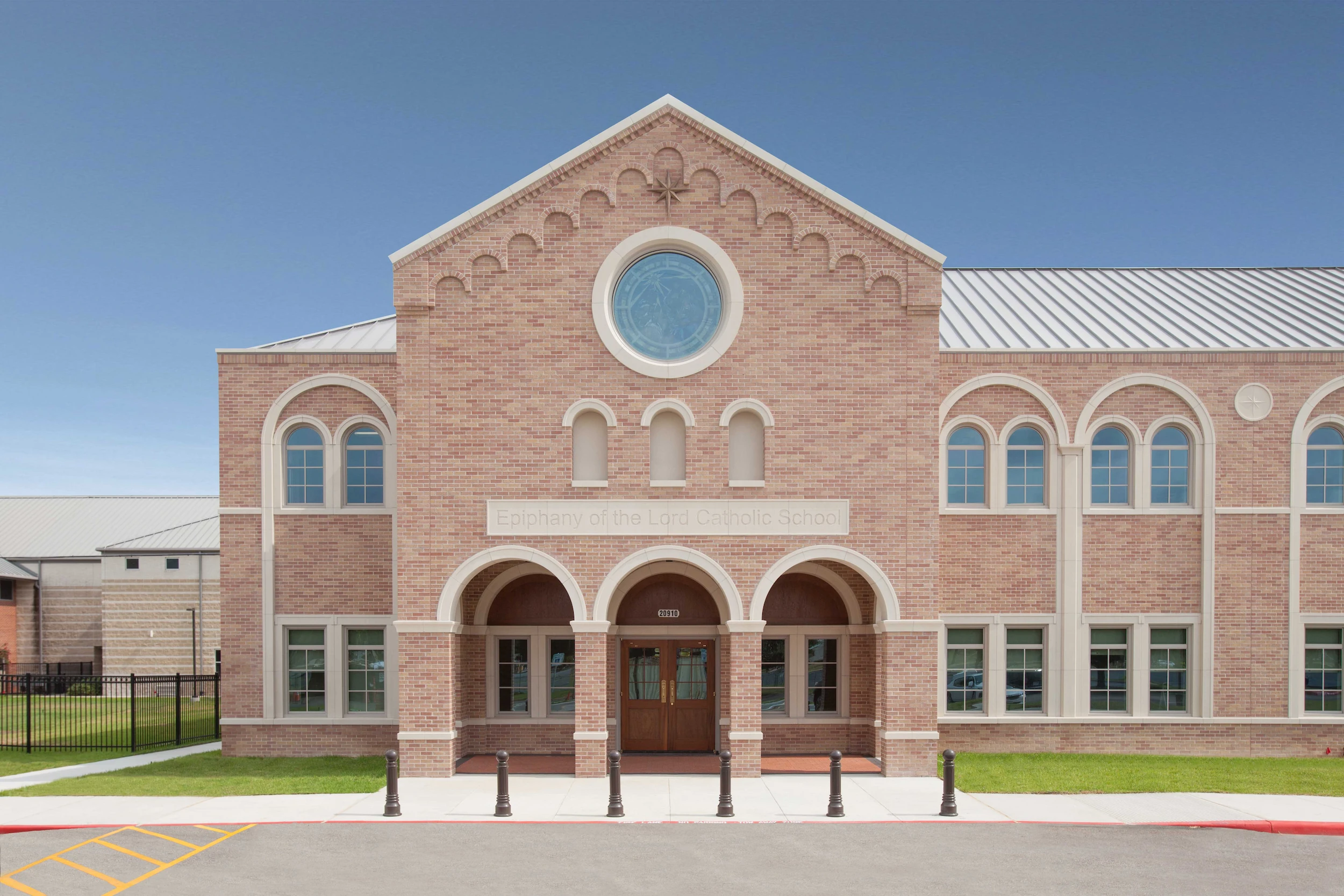
Middle School
Strengthening Minds, Deepening Faith
Through challenging academics, spiritual formation, and service, students are prepared to lead with confidence, integrity, and compassion.
The Middle School program at Epiphany Catholic School is designed to challenge students academically while nurturing their spiritual growth, personal responsibility, and leadership skills. Through a strong partnership of faith, scholarship, and service, students deepen their understanding of Catholic teachings, strengthen critical thinking, and develop the confidence needed for success in high school and beyond.
Middle School Curriculum Overview
Core Academics & Enriching Programs
Core
These courses are designed to cultivate a comprehensive understanding of English language arts and reading (literature), grounded in the Texas Essential Knowledge and Skills (TEKS) framework. The TEKS integrate listening, speaking, reading, writing, and thinking through interconnected strands of literacy development, fostering a cohesive approach to language acquisition and expression.
Instruction emphasizes the continued development of foundational language skills alongside comprehension, textual response, exploration of multiple genres, analysis of author’s purpose and craft, composition, inquiry-based research, and academic oral communication. Through authentic reading experiences and reflective writing practices, students progressively build upon prior knowledge, engaging with texts of increasing complexity and nuance. This scaffolded approach cultivates critical thinking skills and prepares students to navigate the evolving landscape of language and literacy with confidence and adaptability.
Middle School students use a Singapore Math curriculum that integrates visual, concrete, and abstract reasoning. Instruction emphasizes conceptual understanding, real-world application, and hands-on problem-solving.
Students explore advanced math concepts including order of operations, geometry, problem-solving strategies, and pre-algebra to algebraic reasoning. The curriculum, supported by TEKS standards, prepares students with the mathematical fluency and confidence needed for upper-level coursework.
The Religion curriculum invites students into a deeper understanding of what we believe, how we worship, and how we are called to live as faithful disciples of Jesus Christ within our Catholic faith. Students will explore God’s covenants throughout the Old Testament, discovering how these sacred stories form the foundation of Catholic tradition and belief.
This course guides students toward a meaningful integration of Catholic doctrine into daily life, helping them build a strong moral foundation rooted in Gospel values. Students will grow in their understanding of the sacred liturgy and the rhythms of the liturgical year, while cultivating a personal life of prayer and spiritual reflection.
Ultimately, students will come to recognize and embrace their call as Catholics to live out the Church’s enduring commitment to social justice and peace—bearing witness to the Gospel and serving as instruments of Christ’s love in the world.
Students will develop a comprehensive understanding of laboratory safety, scientific inquiry, and reasoning. Through guided laboratory and field investigations, students will practice safety procedures alongside environmentally responsible and ethical scientific practices.
Students will gain proficiency with a range of scientific tools and equipment—including laboratory journals and notebooks, beakers, Petri dishes, meter sticks, graduated cylinders, test tubes, balances, microscopes, thermometers, computers, and timing devices—to collect, record, and analyze data. Students will also learn to properly use preventative safety equipment, such as goggles, aprons, and gloves, and will receive training in the use of emergency safety equipment, including eye/face wash stations, fire blankets, and fire extinguishers.
Through the application of empirical evidence, logical reasoning, and rigorous experimental and observational testing, students will learn to analyze and evaluate scientific explanations, fostering the development of critical thinking skills essential to scientific literacy.
Social studies education fosters a comprehensive understanding of the economic, social, political, and environmental forces that shape our world, viewed through the lens of Catholic teaching and tradition. Students develop essential analytical skills—including map reading, primary and secondary source evaluation, and OPTICS analysis—to critically examine history, geography, and culture. Through the study of major historical periods, including exploration, conquest, and settlement, students come to understand how these enduring cycles continue to shape society today, always mindful of the human dignity of all people affected by these historical forces.
Rooted in Catholic Social Teaching, this curriculum forms students in their dual vocation as citizens and disciples of Christ. Students learn their fundamental rights and responsibilities within civil society while embracing the Gospel call to recognize and honor the inherent dignity of every person as made in the image and likeness of God. This formation encourages students to see history not merely as a sequence of events, but as the unfolding of God’s providence and humanity’s ongoing response to His call for justice, solidarity, and the common good.
The social studies curriculum progresses through World Cultures, Texas History, and American History, building a foundation for students to become informed, faithful, and engaged members of both Church and society.
Ancillary
Middle school students receive three hours of visual arts instruction per week.
Students in middle school can select a visual arts semester elective either as General Drawing and Painting or Mixed Media Visual Arts.
Fifth to eight graders are developing a sense of cultural and social awareness and the ability to communicate their responses to different ideas. In the visual arts they develop a richer understanding of language and terminology for describing and assessing their own and other’s work. Principles of Design are introduced and, increasingly, assignments will require students to make greater individual choices. A individual artistic voice will emerge from students who reflect, conceptualize and plan, create with good craftmanship and learn to assess their work.
Inspiration may come from contemporary artists and include current events or social issues that are relevant to our middle schoolers.
Middle School students have the opportunity to work in a variety of artistic media which may include print, textiles, drawing and painting, 3-D work such as clay, metal, or photography. Students also learn to collaborate on projects together.
Students learn how to use the following media:
- Graphite and Colored Pencil
- Markers
- Oil and Chalk Pastels
- Tempera, Watercolor and Acrylic Paints
- Paper and Fiber
- Air-dry Clay, modeling clay or paper-based
The curriculum focuses on:
- Elements of Art
- Principles of Design
- Collaboration
- Historic and cultural connections
- Visual literacy
- Play
- Safe use of tools and materials
Middle School students may choose Choir or Band as an elective.
- Band:
The Pre-Band program introduces beginner-friendly woodwind instruments and prepares students for seventh and eighth grade band. Students strengthen music literacy, playing skills, and performance confidence through multiple opportunities throughout the year. - Choir:
Choir students study high-quality sacred and secular music while developing vocal technique and music literacy. The choir leads liturgical services, including weekly Mass, and performs regularly throughout the school year.
The Epiphany Catholic School Library supports Middle School students’ research, literacy, and independent learning needs. Students visit the library weekly as needed for checkout and may visit throughout the week with teacher approval to read, borrow materials, or conduct research using print and digital resources.
The Middle School Physical Education program emphasizes wellness, teamwork, and lifelong fitness. Students engage in activities that include:
- Participation for enjoyment and challenge
- Offensive and defensive strategies in modified sports
- Aerobic and anaerobic fitness training
- Goal setting and skill development
- Understanding muscular and skeletal systems
- Use of technology to monitor physical progress
- Weight training awareness and safety
- Health workshops focused on compassion, empathy, and informed decision-making
Students build language proficiency through a combination of grammar instruction and thematic vocabulary. Lessons provide comprehensible input using technology as a supplement, helping students grow in reading, writing, listening, and speaking skills while developing cultural awareness.
In Middle School STEM, students apply science and math concepts through authentic engineering design challenges. Instruction emphasizes self-directed learning, research, communication, and problem-solving.
Students think and work like engineers as they explore real-world applications of engineering, science, and computer science. Through hands-on projects, students become creators, designers, and change-makers while strengthening critical thinking and innovation skills.