Lower School
Growing in Knowledge, Guided by Faith
Students develop academic skills, moral character, and a love of learning while deepening their relationship with Christ.
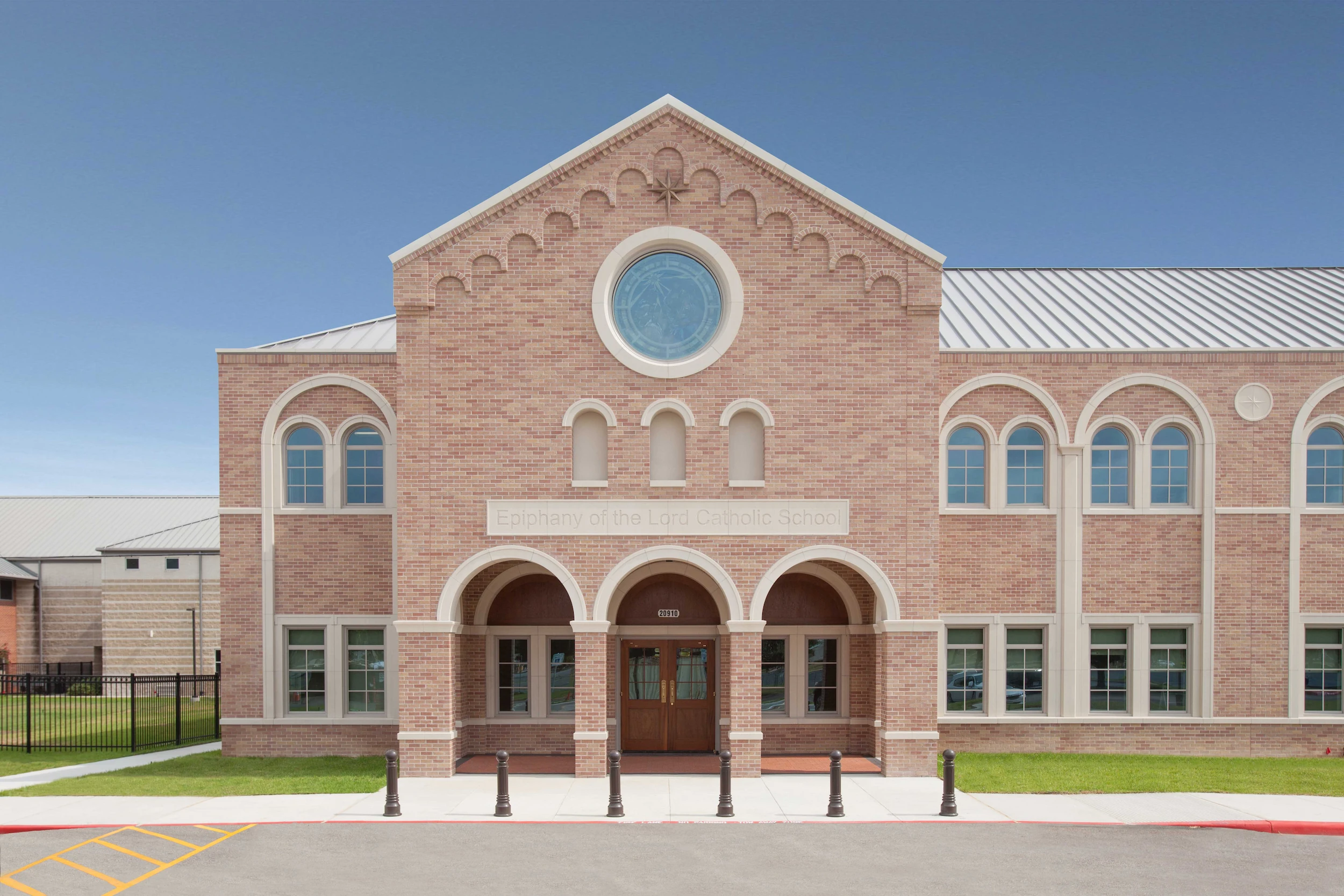
At Epiphany Catholic School, the Lower School program builds upon students’ early foundational skills while continuing to nurture their intellectual, spiritual, physical, and emotional growth. Through a balance of rigorous academics, hands-on learning, and Catholic values, students are encouraged to think critically, discover their God-given gifts, and grow as compassionate members of our faith-filled community.
Lower School Curriculum Overview
Core Academics & Enriching Programs
Core
Language Arts includes English, Grammar, Vocabulary, Handwriting, Writing, Spelling, and Reading.
- In First and Second Grade, our Language Arts program utilizes a comprehensive, phonics-based approach, integrating decoding strategies, sight word recognition, and small-group guided reading instruction. Handwriting, grammar, and writing are woven throughout the program, fostering a well-rounded understanding of the English language while supporting each student’s individual growth and pace.
- In Third and Fourth Grade, students engage in a Book Club format, designed to deepen comprehension skills through rich, meaningful discussion of novels and literary components. Grammar, vocabulary, cursive handwriting, and writing instruction are further developed through carefully selected supplemental resources, seamlessly integrated into our academic program to nurture continued growth, independence, and individuality in every student.
- Spelling
- Our Phonics and Language Arts program for Third through Fifth Grade builds upon a strong foundation in the 70 basic phonograms, reinforcing students’ mastery of reading and spelling as they advance toward greater fluency and independence. Students continue to apply phonogram knowledge to more complex vocabulary, spelling patterns, and multisyllabic words, strengthening their decoding and encoding skills.
- Spelling
At this stage, instruction moves beyond foundational phonics toward deeper application — including grammar, sentence structure, composition, and vocabulary development — while continuing to reinforce spelling accuracy through phonogram-based instruction. This structured, sequential approach ensures students in Grades 3 through 5 develop into confident readers, capable spellers, and clear communicators, prepared for the increasing academic demands of the upper elementary years.
The enVision Mathematics Texas Edition provides students with a rigorous, standards-aligned foundation in mathematical thinking, fully aligned with the Texas Essential Knowledge and Skills (TEKS). This comprehensive curriculum emphasizes conceptual understanding, procedural fluency, and problem-solving through a research-based, visual approach to instruction. Students engage with mathematics through a problem-based learning structure that encourages exploration, discussion, and discovery before formal instruction, allowing them to build understanding from the ground up rather than simply memorizing procedures. Interactive visual models, hands-on activities, and real-world applications help students make meaningful connections between mathematical concepts and their everyday experiences.
The curriculum progresses systematically through essential strands, including number sense and operations, algebraic reasoning, geometry and measurement, and data analysis, with increasing complexity as students advance through grade levels. Ongoing formative assessment and differentiated instruction ensure that all learners—from those needing additional support to those ready for enrichment—can achieve mastery of grade-level standards. By fostering both computational fluency and deep conceptual understanding, enVision Mathematics Texas Edition equips students with the critical thinking and reasoning skills necessary for success in higher-level mathematics and prepares them to apply mathematical thinking to solve authentic, real-world problems.
Our Religion curriculum invites students to continue their journey of faith through the exploration of Sacred Scripture, cultivating virtues of respect, empathy, justice, and peace toward one another and all of God’s creation, grounded in the recognition of God as the Creator of all things. Building upon this foundation, students engage in a deeper study of the truths of our Catholic faith, including the Sacraments, the life and teachings of Jesus Christ, traditional prayers, and the life of the Church community.
Our elementary Science program offers an entirely hands-on, exploratory learning experience grounded in inquiry-based instruction. Across every grade and unit, students engage deeply with scientific and engineering practices, develop a strong understanding of crosscutting concepts (such as cause and effect, and patterns in science), and explore the four core disciplinary areas of science: Life Science, Physical Science, Earth & Space Science, and Engineering & Technology.
Students are actively engaged as they analyze, question, and apply their learning through discovery-based investigations, complemented by rigorous analysis of scientific texts that reinforce and extend their hands-on experiences. This integrated approach cultivates critical thinking, scientific literacy, and a genuine enthusiasm for inquiry and discovery.
Our Social Studies curriculum for First through Fourth Grade forms young people to become informed, reasoned, and responsible citizens of a culturally diverse, democratic society, guided always by Catholic values and teachings. Students explore the world around them through the study of geography, map skills, and the history of Texas, our region, our nation, and the world.
Aligned with the Texas Essential Knowledge and Skills (TEKS) standards, this program builds a strong foundation in civic responsibility, historical understanding, and global awareness, while fostering a deep appreciation for Texas heritage and the traditions of our home state. Rooted in our Catholic faith, students are encouraged to view history, culture, and citizenship through the lens of the Gospel — recognizing the dignity of every person and their call to serve others as faithful members of both their community and the Church.
Ancillary
First to fourth grade students attend weekly art class and experiment with a wide variety of materials and processes. Lessons are designed around themes and use the Elements of Art and improve on their use of these basics over the years. Students are regularly introduced to famous artists and use their work as inspiration and to learn basic art styles and create historical and cultural connections.
Students learn how to use the following media:
- Graphite and Colored Pencil
- Markers
- Oil and Chalk Pastels
- Tempera, Watercolor and Acrylic Paints
- Paper and Fiber
- Air-dry Clay, modeling clay or paper-based
The curriculum focuses on:
- Elements of Art
- Principles of Design
- Collaboration
- Historic and cultural connections
- Visual literacy
- Play
- Safe use of tools and materials
The Epiphany Catholic School Library supports literacy, research, and a love of reading. Students in PK–5 attend weekly library classes for instruction and book checkout. With teacher approval, students may also visit the library throughout the week to read, borrow materials, or conduct research using both print and digital resources.
Lower School students attend weekly music classes aligned with national and state standards. Instruction includes singing, instrument playing, music reading, listening, evaluating, and composing. Students learn about sacred and liturgical music traditions and participate actively in school Masses as choir members and readers.
As students progress, they are introduced to instruments such as recorder, ukulele, and barred xylophone. Performance opportunities throughout the year build confidence and musical expression.
The Lower School Physical Education program promotes physical wellness, teamwork, and personal growth. Students participate in activities that emphasize:
- Enjoyment and challenge through movement
- Positive peer interaction and self-image
- Fitness and stress management techniques
- Aerobic and anaerobic exercise
- Goal-setting and skill improvement
- Understanding the muscular and skeletal systems
- Health workshops focused on compassion and empathy
Students develop basic communication skills using the Total Physical Response (TPR) approach. Through movement, songs, storytelling, reading, and interactive activities, students gain confidence and foundational vocabulary while developing an appreciation for world languages and cultures.
The STEM Lab is a dynamic, project-based learning environment where students explore science, technology, engineering, and math through real-world applications. Students engage in programming, coding, robotics, design, and engineering challenges, including projects using 3-D printers. This hands-on approach inspires creativity, innovation, and problem-solving across grade levels.